Tuesday, November 22, 2011

Seoul in Early November

A few week-ends ago, I had the opportunity to visit Seoul for a day.

Though the weather was a little gloomy, it was interesting to see the Korean country side in early November.  The rice fields were all harvested, and the left over straw was raked up in bales.  And most trees had already lost many of their leaves.  Though it did not look as luscious and alive as it had in the spring time, the Korean landscape was beautiful.  In the autumn rain, it felt calm and serene.
Rice fields, after the harvest

Rice fields, after the harvest.

Korean farms on a rainy autumn day.
Homes and farm buildings by a harvested rice field.
More Korean rice fields, on a rainy autumn day.
Rice fields after the harvest.
A Korean farm after the harvest.
Greens still growing on a Korean farm, in early November.


In Seoul, the ambiance on Sejong daero (세종대로) was fantastic.  In spite of the cloudy weather, people were out enjoying the spectacular scenery of one of Seoul's most beautiful areas.
세종대로 in central Seoul.
King Sejong, GwangHwa gate and GyeongBok palace, at the end of 세종대로.
The statue of General Lee SunShin, on 세종대로.
Buildings by세종대로.
More buildings on 세종대로.
The GwangHwa gate, at the end of 세종대로.
The end of 세종대로.


In Seoul, many of the trees still wore their colourful leaves.  In particular, there were many bright yellow ginkgo trees, which Koreans call "bank trees" (은행 나무), in the alleys by 세종대로.  Koreans love to view the colourful leaves of ginkgo trees in the fall.
The fall colours along 세종대로.
An alley by 세종대로.
An alley near 세종대로.
The same alley, near 세종대로.


Further south, still along 세종대로, Seoul tower could be seen above the buildings.  And near Seoul city hall, there was a park with many old trees, all sporting their brightest fall colours.
Seoul tower, seen from Seoul city hall.
The autumn colours near Seoul city hall.
Colourful trees near Seoul city hall.
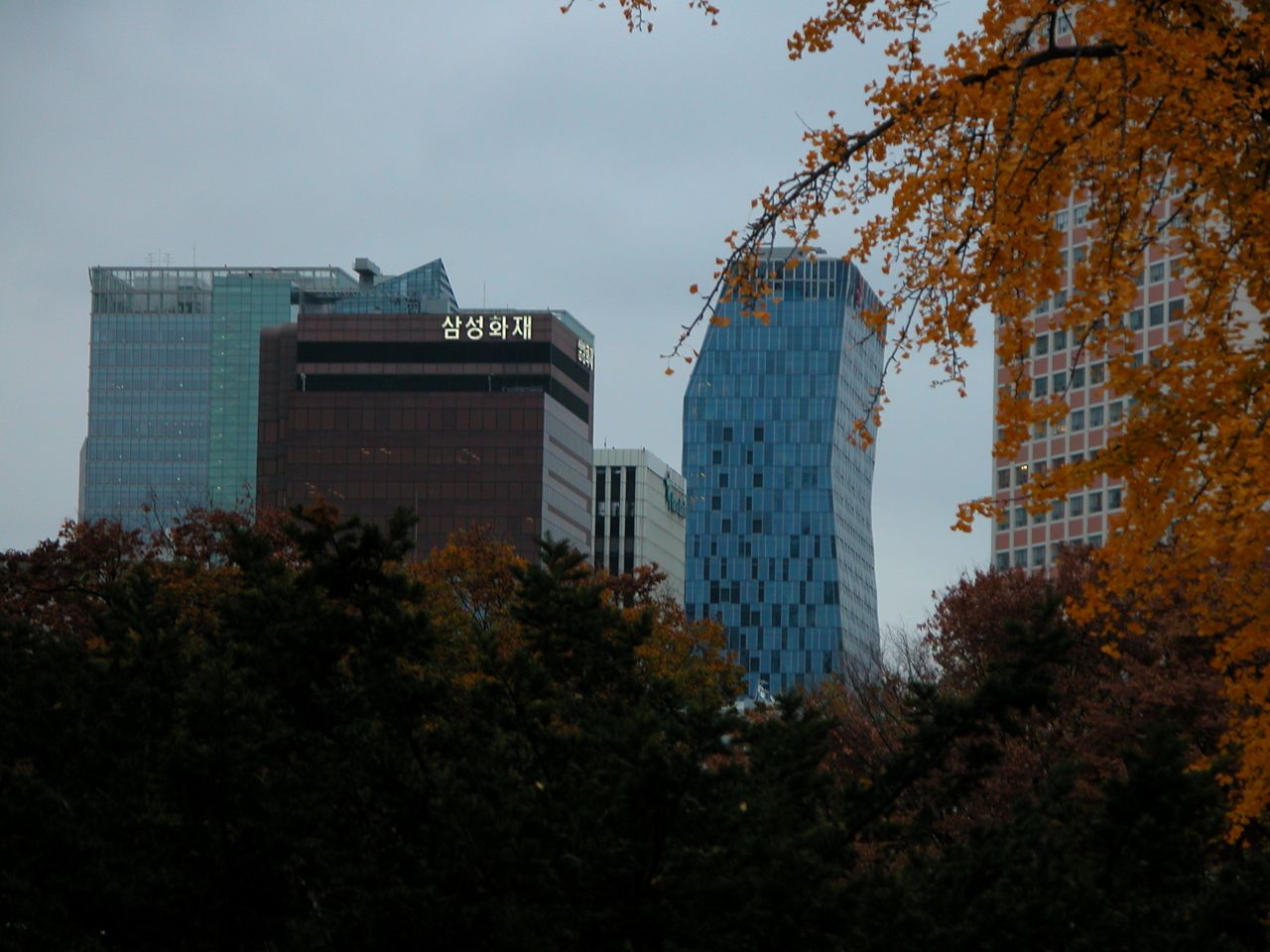
Colourful trees framing the skyline of central Seoul.


At sunset, the lights gave the city a romantic allure.
Seoul tower, illuminated in the early evening.
Christmas lights by the Lotte department store, in central Seoul.

I really like Seoul!  It's a great city!

Sunday, November 20, 2011

Waiting for Autumn in Busan

Where I grew up, the autumn season kicks in around the middle of September.  In October, the leafy trees are at their most colourful.  And by November, there are no more leaves in the trees and the snow sometimes already begins to fall. 

Things are pretty different in Busan.

Here, by late September, the tropical summer heat is finally gone, but the leaves of only a few trees begin to change their colour.  And it seems that only those trees that are located on the edge of the forested areas of the city change their colour.
Some red leaves in Busan, in September.
The trees in a park on the edge of Baekyang mountain, in September.
Small trees by a trail on the edge of Baekyang mountain, in September.

Some of the trees near the top of the mountains change their colour in September or October, but generally, most trees remain pretty green.
The crest of Baekyang mountain, in late September.
A small mountain by the Hoedong reservoir, in mid October.

I think that the trees change their colour gradually in Busan because the temperatures in October and November are quite mild.  Though a cold wave is passing through Busan this week-end, daytime temperatures were as high as 20 degrees Celcius even last week.  And for much of October, the difference between the nighttime and daytime temperatures in Busan has been only 2 -5 degrees.  Also, the weather cools very gradually here in autumn.  Because of this, I believe that different species of trees change colour at different times here.  In contrast, the rapidly cooling temperatures during the Canadian autumn cause most of the trees to change colour pretty much at the same time.


Though the trees in Busan do not offer quite so spectacular a show as do the trees in Canada (or in other parts of Korea for that matter), September and October are beautiful months here.  Notably, the sun sets earlier and earlier in the evening.  By late October, sunset occurs around 6PM.  It's often a beautiful sight, especially along the ocean front.
The sun setting at GwangAn beach, in early November.
GwangAn beach just after sunset, in early November.
 

Thursday, November 17, 2011

Jeju Island, Natural Wonder of the World

On November 11, a Swiss organization called "New7Wonders" announced the results of a competition it had orchestrated, the purpose of which was to identify a new list of 7 natural wonders of the world.

This contest was conducted in two stages.  During the first stage, people from all over the world were invited to nominate natural sites or entities that they deemed worthy of the title "wonder of nature".  In total, 28 nominations were retained for the second stage of the contest, including Canada's Bay of Fundy.  Also nominated was Korea's Jeju island (제주도).

The Bay of Fundy is located on Canada's Atlantic coast, between the provinces of New Brunswick and Nova Scotia.  It is the site of the world's highest tides, averaging a separation of 14.5 meters between the low-tide and the high-tide water levels.  It is apparently very beautiful, but I have yet to visit this part of my country.

Korea's 제주도 is an island located in the Pacific Ocean, near the south-western tip of the Korean peninsula.  It is a volcanic island, and the highest mountain in all the Korean territories, Halla mountain (한라산), is located there.  It is also apparently very beautiful.  I have yet to visit, but many Koreans have recommended that I make the trip down there.

After the nomination stage, the voting stage of the "New7Wonders" contest began.  On November 11, it was announced that 제주도 had been selected (elected?) as one of the world's seven new natural wonders, but not the Bay of Fundy.

Those who campaigned in support of the Bay of Fundy in Canada expressed their disappointment at the results announced on September 11.  Yet they recognized that the contest in itself brought much publicity to the Bay of Fundy region, and they felt that this may translate to more tourism dollars for the region in the immediate future.

In Korea, the election of 제주도 was celebrated, yet one editorial criticized the "New7Wonders" competition, arguing that Korea may have had an advantage in the competition over other nations given its relatively large and dense population, and that "government employees in Jeju were assigned 500 calls a day per person to vote for Jeju night and day".
A subway advert in Busan urging people to vote for 제주도 in the 7 wonders contest.
 

How political this contest appears to have been!  Still, it was an interesting way of sharing information about the world's most beautiful natural places.

Wednesday, November 16, 2011

A November Sunrise in Busan

Yesterday, on one of the coldest mornings of the autumn so far, there was a spectacular sunrise in Busan.
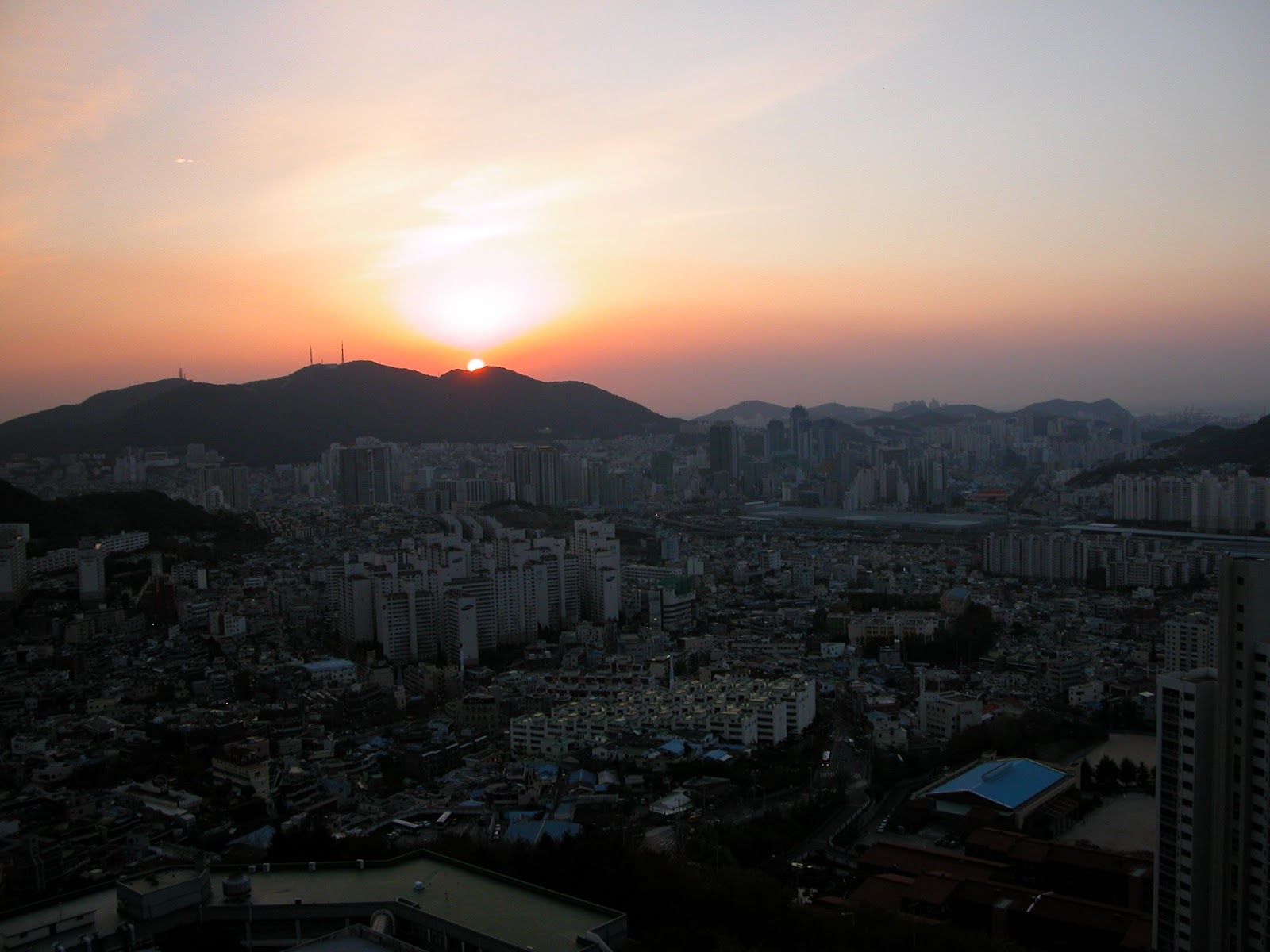
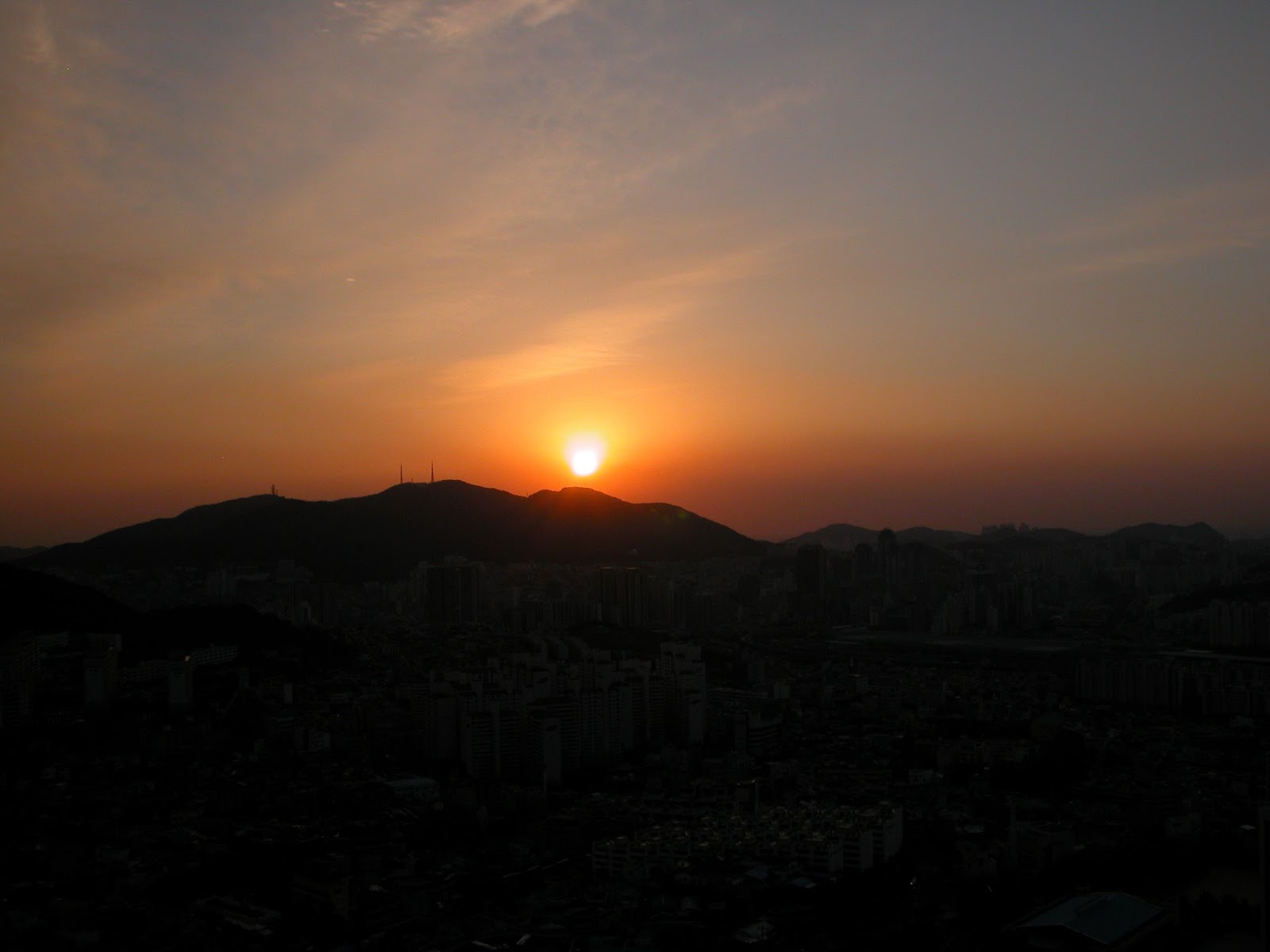
The sun rising over 금령산 and 금련산.
The sun above 금령산 and 금련산.

It was a nice start to an otherwise stressful work day.

Saturday, November 12, 2011

11월11일이 빼빼로데이 있어요

Each year, on November 11, Koreans celebrate Pepero day!

Pepero day is similar to Valentine's day.  On Pepero day, I was explained, men should buy Pepero candy (빼빼로) for their sweethearts.  It is held on November 11 because on this day, the date can be written 11-11, which looks like 4 pieces of Pepero.  The original Pepero candy consists of sticks of baked dough dipped in chocolate.  It was first marketed by Lotte corporation in 1983.

Actually, this year's Pepero day has been deemed a "millenium" Pepero day, as today, the date is 2011-11-11.  Six 1's in a row in a date will happen only once this millenium.  But I suppose that in 2111, there will be seven 1's in a row in the date on November 11.
 A package of the original Pepero candy.
There seems to be some controversy about the origin of Pepero day.  According to one account, it was started by school girls in Busan in the 1990's.  But some Koreans see it as only a commercial holiday, probably started by Lotte.  Yet, Lotte representatives deny that the company started the Pepero day fad, but admit to selling more Pepero in early November than any other time of the year.


Over the years, many different varieties of Pepero candy have been created.  Lotte's Pepero candy is now available in strawberry flavour, peanut and chocolate flavour, and others.
Newer Pepero flavours.
But in addition to this, many other bakers and candy makers sell Pepero-like treats around November 11th.
Pepero-like candy on sale at a "Tous les jours" bakery in Danggam dong.


It is possible to distinguish an amusing sexual undertone in the Pepero day ritual.  To paraphrase an American colleague of mine, it is amusing that a romantic holiday should be marked by men giving their girlfriends candied sticks.  And this year, the "Tous les jours" bakery chain sold Pepero day treats in a box labelled "love choco stick".
"Love choco stick" Pepero day treats.


But what is most interesting for me is that the Pepero day treats sold by the "Tous les jours" bakery chain come in boxes decorated with little men in red suits and tall black hats, sometimes carrying muskets.  In my eyes, these figures are unmistakably British empire soldiers.
A Pepero day marketing brochure from 2010.
Pepero day treats in 2011.
The presence of British soldiers on the package of candy manufactured explicitly to be sold on November 11 is striking to me, as November 11 is an important military holiday in British Commonwealth countries like Canada.  On November 11, 1918, the First World War was ended in Europe.  In Canada, November 11 is known as "Remembrance day".  It is Canada's version of the American Veteran's day.

I attempted to ask the staff at my local "Tous les jours" bakery why their Pepero day treats are decorated with such obviously British symbols.  They could not tell me, possibly because they could not understand what I was asking in my very broken Korean.  But I speculate that these symbols are not meant to evoke British culture, but French culture.  November 11 is an important day in France too, as the First World War was almost entirely fought on French soil.  For this reason, I believe that the marketers at the French-themed "Tous les jours" bakery have elected to use symbols evoking the European November 11th tradition on the packaging of Pepero day treats in Korea.

Thursday, November 3, 2011

Snow Cake - A Movie Taking Place In Northern Ontario

While on the topic of Canadian films...

This Movie Is Broken is an urban film, showing events that take place in the Canadian metropolis of Toronto.

Downtown Toronto.
Downtown Toronto.
Front street in Toronto.
Downtown Montreal.
Ottawa at dawn.
Downtown Vancouver, beyond English bay.

But even though most Canadians (about 80% according to Statistics Canada) live in cities like Toronto, Montreal, Vancouver, and others, Canada is a large country with many rural spaces.
The Saint-Lawrence river, near the village of Kamouraska, Québec.
A farm, somewhere in southern Québec.
A covered bridge, near Gatineau in western Québec.
An old farmhouse and tractor, near Sudbury, Ontario.
Farmland near Sudbury, Ontario.
Homes by the Vale-Inco smelter, in Sudbury, Ontario.
The western prairie, in Manitoba.
The Qu'Appelle river valley, in Saskatchewan.
The western prairie, in Alberta.

The film Snow Cake, released in 2006, provides an interesting look at life in Canada's less populated regions.  Filmed in Wawa, Ontario, a picturesque town located just north of lake Superior, it is a drama about a man named Alex who picks up a young hitch-hiker as he is driving across northern Ontario to Winnipeg.  Shortly thereafter, the pair are involved in a traffic accident, and the hitch-hiker dies.  Having himself lost his own son in a car accident, Alex decides to visit the hitch-hiker's mother, Linda.  When he meets Linda, he realizes that she is autistic.  So, he decides to stay in town for a few days, until Linda's daughter's funeral.  During this time, Alex encounters many of the residents of the small northern Ontario town that is Linda's home, and he comes to terms with some dramatic events that happened in the early part of his life.

Snow Cake is a heartwarming and touching film.  I have watched it a few times, and each time, it has made me nostalgic for home.  It contains beautiful scenery of northern Ontario in the winter, and the characters in the film have personality traits and idiosyncrasies that remind me of people I know well back home.  And furthermore, its soundtrack has been produced by Broken Social Scene.
The original Wawa goose, in Wawa Ontario.
The main street in Wawa.
The Trans-Canada highway, near Wawa.
Trucks on the highway, near Wawa.

Snow Cake has both a long trailer and a short trailer.