Showing posts with label 강원도. Show all posts

Friday, March 23, 2012

HaeSinDang Park - 해신당 공원

In addition to its snowy mountains, its lookout into North Korea, and its familiar-feeling small industrial towns, GangWon province is home to one of the most unique parks I have ever visited, HaeSinDang park (해신당 공원).

I visited 해신당 공원 on a lightly overcast afternoon.  In the winter sun, the almost snow free landscape of the park showed off its many tones of brown, while occasionally sporting evergreen hues.  The first section of the park was deserted, and serene...  perfect for a quiet winter afternoon walk.
해신당 공원, on a cold January day.
Another view of 해신당 공원.
Dry grass in 해신당 공원

But I soon came upon the park's main attraction, an attraction that draws to it visitors from all over Korea, and it transformed into something more light-hearted and cheeky the serene mood that I had cultivated in the park's natural landscape.  You see, 해신당 공원 is a sculpture park, and certainly one of the most unusual ones I have ever heard of.  Here are some of the first sculptures that I saw in the park: 
A sculpture in 해신당 공원.
Another sculpture in 해신당 공원.


Having first stumbled upon some of the more subtle of the park's sculptures, it didn't take long for me to find some of the more realistic ones.
A bench in 해신당 공원.
In case you needed a close-up of the sculpture to see what it is...  :)

That's right, 해신당 공원 is a penis park...  a theme park dedicated to sculptures of the human male's favourite reproductive organ.


By my estimate, the park is home to more than 50 penis sculptures, some of them silly...
A laughing penis and his friend, in 해신당 공원.
A penis in a robe.
... others more realistic looking...
A penis canon.
Penises by a pond, in 해신당 공원.
Seems that a woodpecker thought that this wood pecker would make a good home.  (Sorry.)  :)

해신당 공원 is on the GangWon coast, and the coastline by the park is also beautiful.
Looking down to the East Sea from a steep hill in 해신당 공원.
The GangWon coast, from 해신당 공원.
Rocks by the East Sea shore, in 해신당 공원.
Just outside of 해신당 공원, there is a little harbour with a lighthouse marking its entrance, the shape of which is in keeping with the park's theme.
A harbour lighthouse, just outside 해신당 공원.


So why is there a penis park in southern GangWon province?  Because the people living in the area near HaeSinDang park have an interesting cultural legend, known as the legend of HaeSinDang.

According to the legend, there once lived in HaeSinDang a young woman named AeRang (애랑) who was engaged to a fisherman named DeokBae (덕배).  One morning, 애랑 went out to sea with 덕배 as he went to work, and he dropped her off on a rock so she could collect some seaweed.  He was going to pick her up again on his way back home in the evening, but the weather changed suddenly and he was not able to go back to the rock to find her.  So, 애랑 drowned.

After her drowning, the fishermen of HaeSinDang started having difficulty catching enough fish.  Until the day that one of them realized that if he urinated while facing the ocean in the morning, his catch would be much better.  He concluded that the fish must be perturbed by the spirit of 애랑, as her spirit must be sexually frustrated.  He also understood that, if he showed 애랑's spirit his penis,  her frustration eased and she did not disturb the fish so much.  And so from that day on, the fishermen of HaeSinDang presented their penises to the ocean before going fishing, and this greatly improved their catch.


The woman in this legend, 애랑, is a local goddess in the region near HaeSinDang.  There is a small shrine dedicated to her in 해신당 공원.  As I passed it on my way out of the park, someone placed an offering in the shrine and prayed to 애랑.
The shrine to 애랑, in 해신당 공원.


A final note...
I learned the Korean word for penis when I visited 해신당 공원.  In Korean, a penis is a "nam geun" (남근).
I can't be sure of the etymology of the word, as the Korean language has many words borrowed from the Chinese language, many of which sound almost the same but are written using different characters.  Often, Koreans will want to know the Chinese spelling of a word in order to clearly differentiate it from a number of other similar-sounding options.
Having said this, I think that the word "nam geun" is a compound word.  The word "nam" (남) means "male".  I encounter this word quite commonly, as the Korean word for "man" is "nam ja" (남자), which literally means "male person".  Also, one meaning of the word "geun" (근) is "muscle".
So in Korean, a penis is a 남근, or a "male muscle".

동해시, the East Sea City

On the eastern coast of Korea, in Gangwon province, there is a town called "East Sea City" (동해시). 


It's not a big city.  It's center consists of essentially one street, leading from a 4-way crossroad to the 동해 train station.  It's skyline, three or four stories tall at most, is framed in the distance by a pretty large mountain.
The town center of 동해시.

동해시 felt strikingly familiar to me.  Why?  Because on the east side of 동해시, there is some kind of industrial installation.
The industrial plant at 동해시.
Another view of the industrial plant in 동해시.
Walking to work while a dog rests in the winter sun?
It seemed to me that this industrial plant was probably the only major place of work in 동해시, and that 동해시 is a one-industry town.

 
There are many such towns in northern Ontario.  Towns like Timmins, Copper Cliff, Onaping, Falconbridge, and so many others are industrial towns similar to 동해시.  Usually most of the residents of these towns work for one or two mining or forestry companies.  I grew up not far from many such towns.
The smelter at Copper Cliff, near Sudbury, Ontario.
A street in Copper Cliff, leading to the smelter.

If it wasn't for 동해시's karoake bar, a Russian bar named "Texas"...
The "Texas" karaoke bar in 동해시.
...  I might have mistaken it for an Ontarian industrial town.  Even the church in 동해시 looked like those often found in Ontario's industrial towns.
The church in 동해시.


Another Canada connection...
I was in 동해 to take a train.  I got there way too early, and so spent a little time exploring around town.  When it was time to catch my train, I headed back towards the train station.  It was early afternoon.

As I was walking down the main drag, the train station a few block ahead in my field of view, a man yelled at me from across the street.  "What is your name?", he shouted in perfect English.  I wasn't sure how to react to him, but decided to cross the street and introduce myself.  "I'm JP", I said, following that up with a "반갑습니다".  "Nice to meet you too", he responded, and told me his name.  "Where are you from?", he continued.  "Canada", I said.  "Really!", he exclaimed.  "I used to work in Canada!  I have a business there.  I sell Korean foods to restaurants and grocers in the Toronto area.", he said, much to my surprise.  He then proceeded to explain that he had lived in Canada for many years, had established a Korean food franchise in southern Ontario, and was now back home in 동해 to retire.  By that point, his wife had come out of their home to speak with me too, and she stated that they were now back in Korea because her husband's health was deteriorating.  He had had an accident when he was younger, and was now suffering from the aftereffects of this accident.

They seemed so happy to speak to a Canadian, especially one from so close to Toronto, that they invited me into their home and offered me a free meal.  But my train was coming soon, and I could not accept their offer.  So I thanked them, shook their hands, and then headed off, smiling in amazement that 동해시 and my home in Ontario, though more than 10,000 kilometers apart, are more closely connected than I could ever have imagined.

Tuesday, March 20, 2012

The Northernmost Location in South Korea

Gangwon province was hit with a snowstorm today.  It seems that March tends to bring a lot of snow to that province.  But earlier in January, Gangwon province had surprisingly little snow, even at its northernmost point.

The northernmost point in Gangwon province is also the northernmost point in South Korea.  It is known as the Tong-Il Unification Observatory (통일전망대).  The Tong-Il observatory is located in the demilitarized zone, the border region separating North and South Korea.  From there, it is possible to see North Korean territory.  And the coastline by the Tong-Il observatory is gorgeous!
Military hardware from the Korean war, at the Tong-Il Unification Observatory.
Looking southward at the east coast of South Korea, from the Tong-Il Unification Observatory.
Looking northward at the east coast of North Korea, from the Tong-Il Unification Observatory.

From the Tong-Il observatory, I could see no activity in North Korea.  But to my surprise, there was a highway crossing the border between the two Koreas, and it was completely deserted. 
An empty highway, crossing the DMZ from South to North Korea.
It is only after I returned form the Tong-Il observatory that I learned of the mount GeumGang tourist regionMount GeumGang (금강산) is a legendary mountain located near the inter-Korean border, in North Korea.  Since the late 1990's, South Koreans had been allowed to go on vacation tours to visit the mountain.  But in 2008, a South Korean tourist was shot and killed by North Korean soldiers while she was visiting the 금강산 tourist region.  Tours from South Korea to 금강산 have been suspended since then, and the highway from South Korea to the 금강산 tourist resort remains deserted. 

금강산 itself can be seen, in the distance, from the Tong-Il observatory.
Mount GeumGang (금강산), as seen from the Tong-Il Unification Observatory.

Saturday, March 17, 2012

설악산의 눈

My first real encounter with snow, this winter, was on Seorak moutain (설악산).

Seorak san might be Korea's most famous mountain.  It is in Gangwon province, part of the Taebaek mountain range.  The mountain, and the area around it, is a national park.  It is a particularly popular tourist destination in the autumn, when the leaves become colourful.  But I'm glad I saw it in the winter, as there were very few visitors there when I went.  It was beautiful, and serene.

The entrance of Seorak mountain national park (설악산 국립공원)
Sokcho city (속초시) and the Pacific ocean, as seen from Seorak mountain.
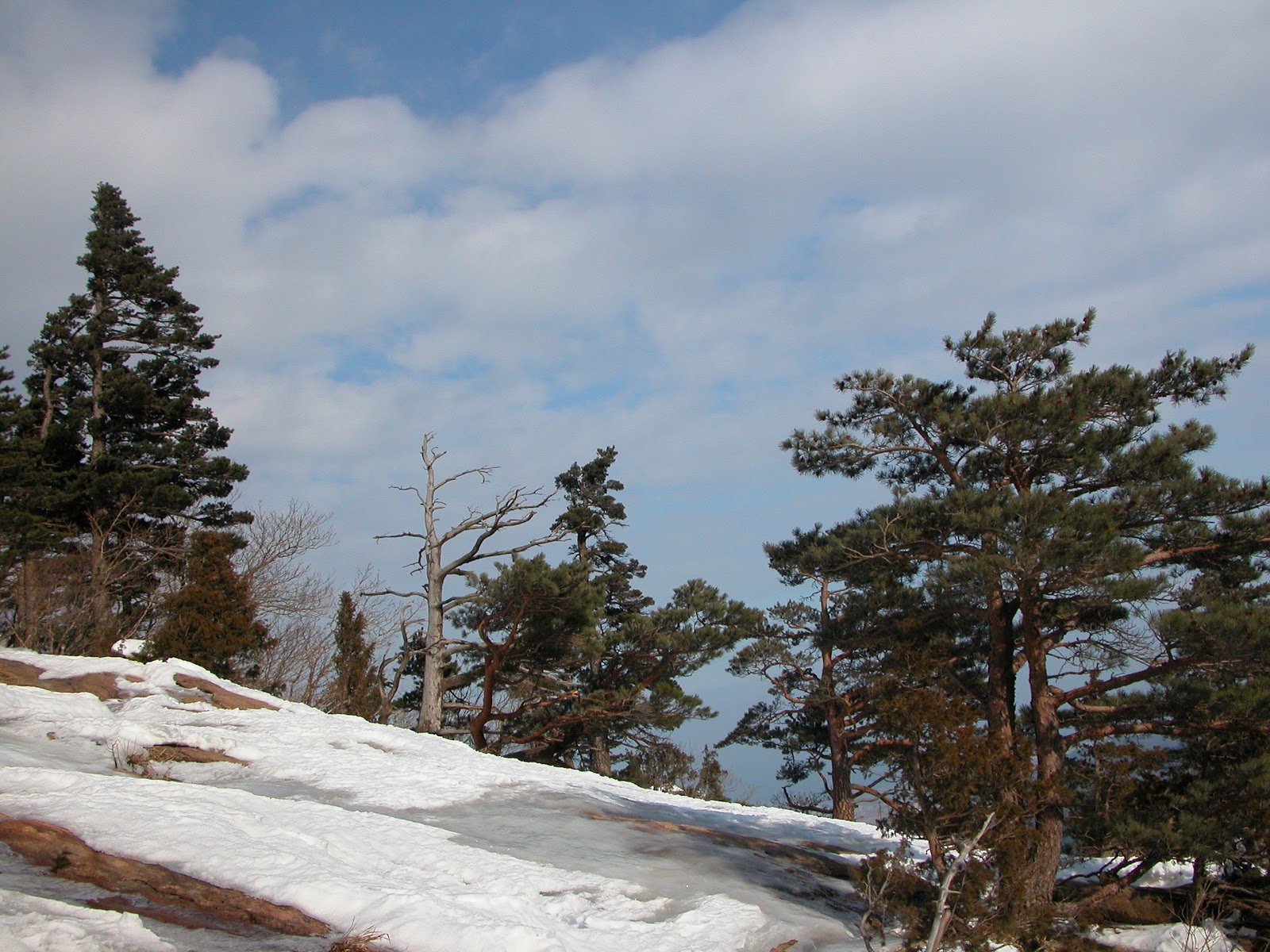
A winter scene, on Seorak mountain.
A view of Seorak mountain.
More snow on Seorak san.
More mountains in Seorak san park.
Near the summit of Seorak mountain.
Seorak san park in late afternoon light.
Another view of Sokcho and the Pacific, from Seorak mountain.